
Defense against Wildfire #2 Mountain Terrain
- FireFly FireCoatings
- Jul 14
- 3 min read
Welcome back, Colorado! Today, we're diving into Part Two of our series, Defense Against the Dark Arts of Wildfires. Our focus for this lesson? Mountain Terrain.
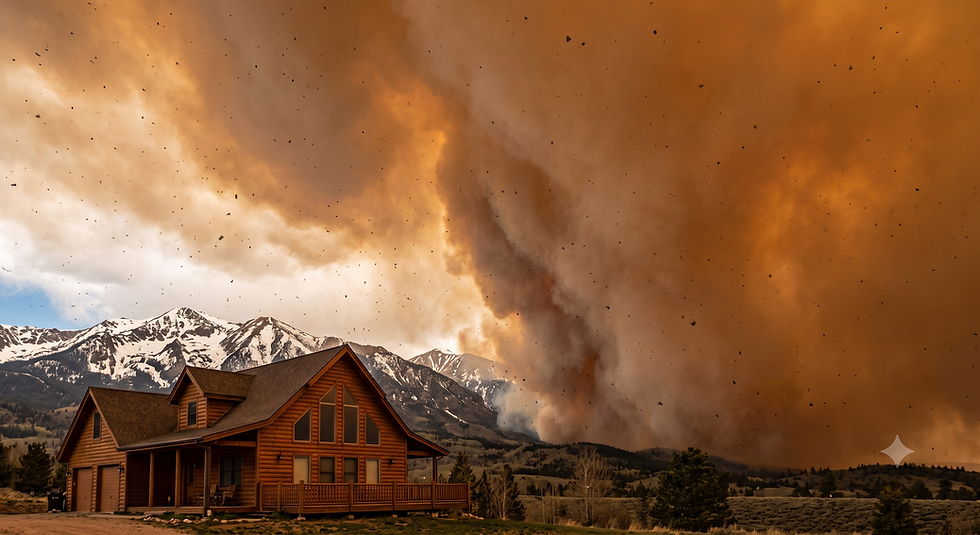
If you live in the Rockies, you already know that our beautiful landscape comes with unique risks. The main culprits amplifying wildfire danger in mountainous areas are slopes, canyons, valleys, and ridgetops. Let’s dive deeper into how this terrain affects fire behavior and explore essential wildfire mitigation strategies.
1. Slopes: The Accelerators of Wildfire
It’s a known fact in fire defense: wildfires on slopes burn hotter, move faster, and produce significantly longer flames than fires on flat ground. For every 10% increase in slope, the length of the flame doubles. This means a grass fire producing 6-foot flames on flat ground will surge to 24-foot flames on a 20% slope—more than enough to jump into the tree canopy and threaten homes. Furthermore, soil on steep inclines dries out much faster, leaving vegetation highly ignitable.
Slopes present a secondary wildfire protection challenge: maintenance. Steep terrain is difficult and expensive to clear. Heavy machinery is often impractical, labor costs increase, and the risk of injury deters routine brush clearing. Here in Colorado, where homes are nestled into these steep hillsides, extra defensible space precautions are non-negotiable.
Don't leave your property vulnerable. If you live in a high-risk area, consider getting a free evaluation for our premier fire defense services. At https://www.rockymountainwm.com/book-online, we provide the fire-stopping power to make your home a fortress. We specialize in fire-resistant coatings for wood, fences, decks, exteriors, and even solar panel protection.
2. Canyons and Valleys: The Wind Tunnels
Narrow geological features like canyons and valleys are particularly prone to extreme fire behavior. This is largely due to the "Venturi effect"—a phenomenon where winds become compressed and significantly stronger as they are forced through narrow channels. Think of it like putting your thumb over a garden hose to make the water shoot further and faster.
Features like gorges, passes, ravines, saddles, and trenches act as natural wind tunnels, fueling rapid fire spread. Historically, many of the nation’s most devastating wildfires have ripped through canyons. Because wildland firefighters often have to establish containment lines at the top of these ridges for safety, mid-slope homes are left highly vulnerable. This makes proactive home hardening and property fire mitigation critical for residents in these valleys.
3. Ridgetops: The 360-Degree Threat
While the views are breathtaking, properties situated along ridgetops face perhaps the most severe risk. Because fires burn uphill rapidly, a ridgetop home can face incoming flames from a full 360 degrees.
Ridgetop property owners must take an active role in their own fire safety and property protection. In severe scenarios, access roads may be cut off, leaving you isolated from community resources. If local fire agencies designate your ridgetop as a strategic defense line, expect strict enforcement of fire mitigation codes.
However, if the area becomes too dangerous for emergency personnel, your property must be self-reliant. A robust fire defense strategy for a ridgetop home includes:
Maintaining large caches of stored water.
Independent power supplies (like batteries or generators).
High-capacity water pumps and heavy-duty fire hoses.
Multiple clear escape routes.
Reliable emergency communication links.
Thank you for tuning in to this week’s wildfire safety lesson! We publish crucial fire defense strategies and tips weekly to help you protect what matters most. Stay safe out there, Colorado, and remember to prioritize your defensible space!


Comments