
Protect From Wildfires Smoke Starting inside.
Updated: Jul 22
It seems like every year the headlines are the same: a new record for wildfire smoke, increasing urban smog, or a sudden spike in seasonal allergens. We spend a lot of time thinking about the quality of the water we drink and the food we eat, but we take roughly 20,000 breaths a day with barely a second thought about what we are actually inhaling.
When the sky turns hazy and the air smells like a campfire, staying indoors isn't a complete solution. Buildings are not airtight, and microscopic pollutants easily find their way into our living rooms, bedrooms, and lungs. To truly protect yourself and your family, you need a proactive defense strategy.
Here is why a toolkit consisting of HEPA filters, high-quality masks, air quality monitors, and saline solutions is no longer just for hypersensitive individuals—it is essential gear for the modern world.
The Invisible Threat: Understanding PM2.5
To understand why this gear is so crucial, you first have to understand the enemy. The primary health threat during poor air quality events—especially wildfire smoke—is particulate matter, specifically PM2.5.
The "2.5" refers to the size of the particle: 2.5 microns or smaller in diameter. To put that into perspective, a single grain of fine beach sand is about 90 microns across. A human hair is roughly 50 to 70 microns. PM2.5 particles are so incredibly small that they are completely invisible to the naked eye.
Particle Type | Size (Microns) | Where It Gets Trapped in the Body |
Dust & Pollen | 10+ | Nose and throat (causes sneezing, coughing). |
PM10 | 2.5 to 10 | Upper respiratory tract and large airways. |
PM2.5 | Under 2.5 | Deep lung tissue (alveoli); can enter the bloodstream. |
Ultrafine | Under 0.1 | Crosses the blood-brain barrier and organ tissues. |
When you inhale PM2.5, it bypasses the body's natural defense mechanisms—the mucus in your nose and the tiny hairs (cilia) in your throat. These particles travel deep into the microscopic air sacs of your lungs (the alveoli). From there, they are small enough to slip directly into your bloodstream, triggering systemic inflammation, raising blood pressure, and increasing the risk of cardiovascular and respiratory diseases.
You cannot fight something you cannot see with standard tools. That is where HEPA technology comes in.
HEPA Filters: Your Home's First Line of Defense
Most people assume their home's heating, ventilation, and air conditioning (HVAC) system is purifying their air. In reality, standard fiberglass HVAC filters are designed to protect the furnace motor from large debris like pet hair and heavy dust—not to protect your lungs from microscopic smoke particles.
To actually clean the air you breathe, you need HEPA (High-Efficiency Particulate Air) filtration.
How HEPA Works (It's Not Just a Sieve)
A true HEPA filter is certified to capture at least 99.97% of particles that are exactly 0.3 microns in size. (Interestingly, 0.3 microns is the hardest particle size to catch; HEPA filters are actually even more efficient at catching particles both larger and smaller than 0.3 microns).
Rather than acting like a simple window screen where small things just slip through the holes, a HEPA filter is a dense, chaotic maze of fiberglass threads. It captures particles in three ways:
Impaction: Large particles crash directly into the fibers and stick.
Interception: Medium particles follow the air current but brush against a fiber as they pass, getting snagged.
Diffusion: This is the magic of HEPA. Tiny particles (like PM2.5 and ultrafine particles) don't flow in a straight line. They bounce around erratically—a phenomenon called Brownian motion. Because they are zigzagging so wildly, they inevitably crash into the dense web of fibers and become permanently trapped.
Making It Count
Having a HEPA purifier is only half the battle; sizing it correctly is the other. When buying a unit, you must match its CADR (Clean Air Delivery Rate) to the square footage of your room. A purifier meant for a 150-square-foot bedroom will do almost nothing if placed in an 800-square-foot open-concept living room. During a smoke event, run your properly sized HEPA purifier on its highest setting in the room where you spend the most time, keeping doors and windows firmly closed.
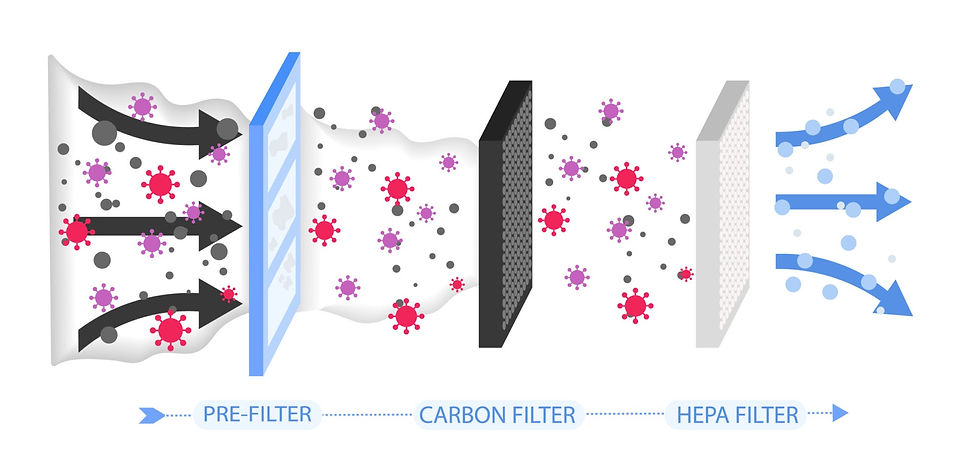
Having the correct filter makes the difference between clean and dirty air. We would recommend getting an air purification system with a true HEPA filter classification. The link below takes you directly to the Amazon page of the WINIX 5510 Air Purifier https://amzn.to/4gSdWKK If you are dont want to sift through 100's of choices we recommend the Winix 5510 Air Purifier. Thousands of positive reviews compliment its effectiveness and features.We receive a recognition for the sale if you use our link to make a purchase.

Air Quality Monitors: Making the Invisible Visible
If you cannot see PM2.5, how do you know if your HEPA filter is actually working? How do you know if the air outside is safe enough to open a window? You cannot rely on your eyes or your nose. By the time you can visibly see a haze in your living room or smell smoke, the PM2.5 levels are already astronomically high.
This is why an indoor Air Quality Monitor is the brain of your respiratory defense toolkit.
A dedicated monitor uses optical laser scattering to count the microscopic particles floating in your room in real-time. It translates this data into an easily readable Air Quality Index (AQI) score or a raw PM2.5 measurement.
Why You Need Your Own Data
Relying solely on your phone's weather app for air quality isn't enough. Weather apps pull data from government sensors that might be miles away from your house, and they only tell you what is happening outside.
An indoor monitor empowers you to take immediate, data-driven action:
Proof of Concept: You turn on your HEPA purifier and can watch the PM2.5 numbers drop from a hazardous 150 down to a safe 10 over the course of an hour.
Leak Detection: If your indoor numbers start creeping up while your doors and windows are shut, you know your home has drafts pulling in polluted outside air.
Energy Efficiency: You don't need to run your purifier on "jet engine" mode 24/7. Your monitor tells you exactly when the air is clean so you can dial the purifier back to a quiet, energy-saving setting.
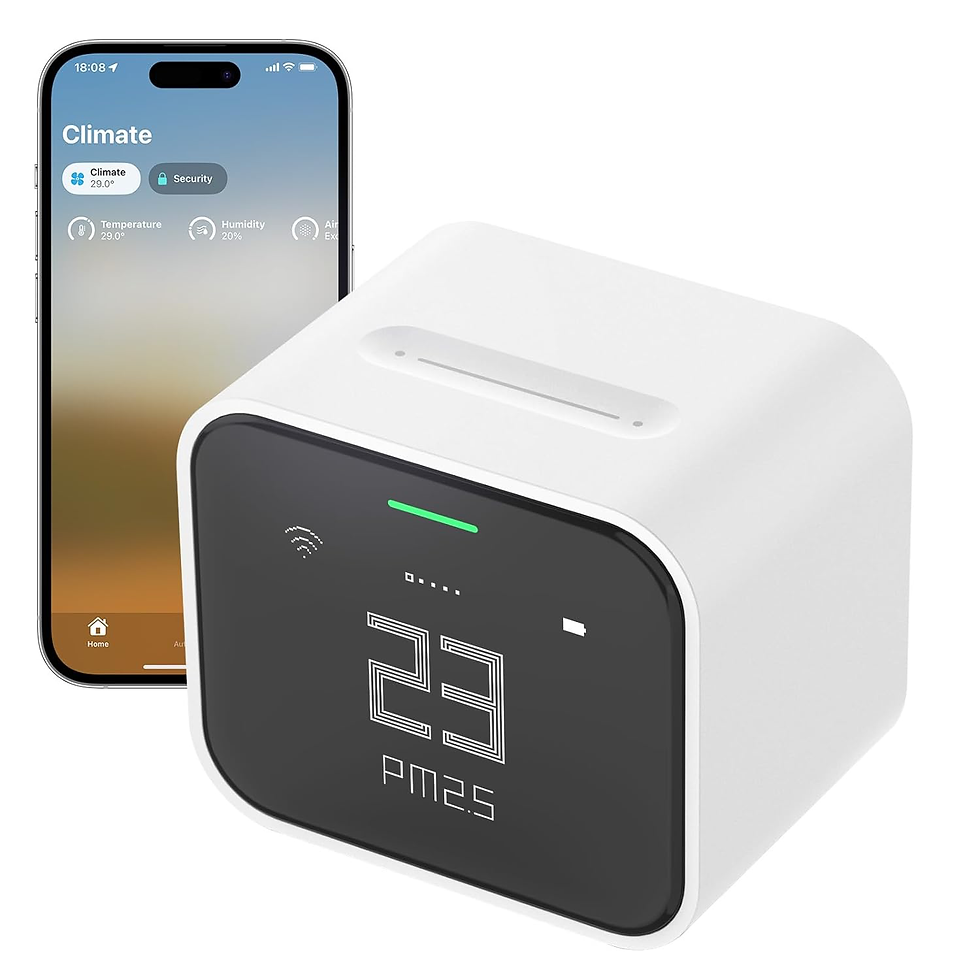
The Qingping Air Monitor Lite featured on this Amazon page. https://amzn.to/4pAKScU
Able to identify pn 2.5 particals this unit is descrete and effective. Get a better picture of the air quality you are breathing. The Pairing to your smart device means you are able to have access at the touch of a button.
High-Quality Masks: Taking the Bubble on the Go
You have secured your home, but life still happens. You have to commute, walk the dog, or run errands. When the AQI outside is in the unhealthy range (generally over 100 for sensitive groups, or over 150 for everyone), stepping outside unprotected is like smoking a pack of cigarettes.
Standard cloth masks, surgical masks, and bandanas are virtually useless against PM2.5. The gaps in the fabric are massive compared to the size of the particles, allowing the smoke to flow right through.
You need an N95, KN95, or KF94 respirator.
The Electrostatic Advantage
These high-quality masks don't just physically block particles; they are manufactured with a permanent electrostatic charge. They act like microscopic magnets, actively pulling the PM2.5 particles out of the air stream and trapping them in the synthetic fibers before they can reach your mouth or nose.
Fit is Everything
The most expensive N95 mask in the world is useless if it doesn't seal to your face. If you feel air blowing into your eyes or out of the sides of your cheeks when you exhale, the mask is leaking. When you inhale, air will take the path of least resistance—meaning it will bypass the filter entirely and slip through those gaps, bringing the smoke right into your lungs.
Pinch the metal nose wire tightly (don't just tent it), ensure the straps are snug, and if you have facial hair, understand that it will compromise the seal.
Bnx makes a reliable form fitting mask that would be perfect to have on hand when the air quailty is bad and you do have to go out. With 4.4 stars on on Amazon this trused mask can offer protection from dirty air, https://amzn.to/4pDXn7x

Saline Solutions: The Unsung Heroes of Respiratory Relief
Even with the best HEPA filters and tightest N95 masks, some level of exposure is inevitable during a severe air quality event. When smoke and pollution do make it into your upper respiratory tract, your body reacts with inflammation. Your nasal passages dry out, your throat gets scratchy, and your eyes burn.
Saline solutions (sterile saltwater) are the simplest, most effective, and most overlooked tools for immediate relief.
Flushing the System
Your nasal passages are lined with a mucous membrane and tiny cilia that act as a conveyor belt, sweeping trapped debris toward your throat to be swallowed and destroyed by stomach acid. Heavy smoke exposure dries out this mucus, paralyzing the cilia and leaving the pollutants sitting against your delicate tissues, causing systemic inflammation and sinus pain.
Saline Nasal Sprays and Rinses: Using a sterile saline spray throughout the day, or doing a full sinus rinse (like a Neti pot with distilled water) after coming indoors, physically washes away the trapped soot, ash, and pollen. It rehydrates the mucous membranes, allowing your body's natural "conveyor belt" to start working again.
Preservative-Free Eye Drops: Smoke particles cause gritty, burning eyes. Regular, preservative-free artificial tears act just like a nasal rinse for your eyes—flushing out the physical irritants and restoring the tear film without the rebound redness caused by medicated drops.
NeilMed Sinus rinse has over 40 thousand positive remoarks for it being simple and effective. A first aid kit should be prepared to handle sinus irritation in whichever foam it occures. We recommend NeilMed Sinus rinse, check it out for yourself at: https://amzn.to/4wikFCx

Taking Control of Your Environment
We can't control the weather, the wind, or the wildfires. However, we are not powerless. Understanding the mechanics of PM2.5 and utilizing the right tools turns poor air quality from an unavoidable health crisis into a manageable hazard.
By running a properly sized HEPA filter guided by a reliable air quality monitor, wearing a well-fitted electrostatic mask outdoors, and utilizing saline to soothe inevitable irritation, you are building an effective fortress for your respiratory health. Don't wait for the sky to turn orange—build your toolkit today.
Our Affiliate Product Links:



Comments